


Rebellion’s latest reboot of the franchise leans fully into this brutality and comes out the other side with a 3D epic. Speedball’s Lead Designer Jim Stimpson and Art Director Sam Beattie were good enough to agree to speak to me about their dystopian creation.
This was an interview I'd been itching to do since Rebellion's acquisition of the Bitmap Brothers catalogue in 2019, which includes likes of Xenon, The Chaos, Engine as well as the Speedball series, though there was never much doubt about which the company would focus on first:
“It was more a group decision," Sam explained. "What games people here loved, and what we thought the market would be excited by. Speedball just naturally presented itself as the frontrunner, because tons of people in the studio were super excited about the idea of bringing it back.”
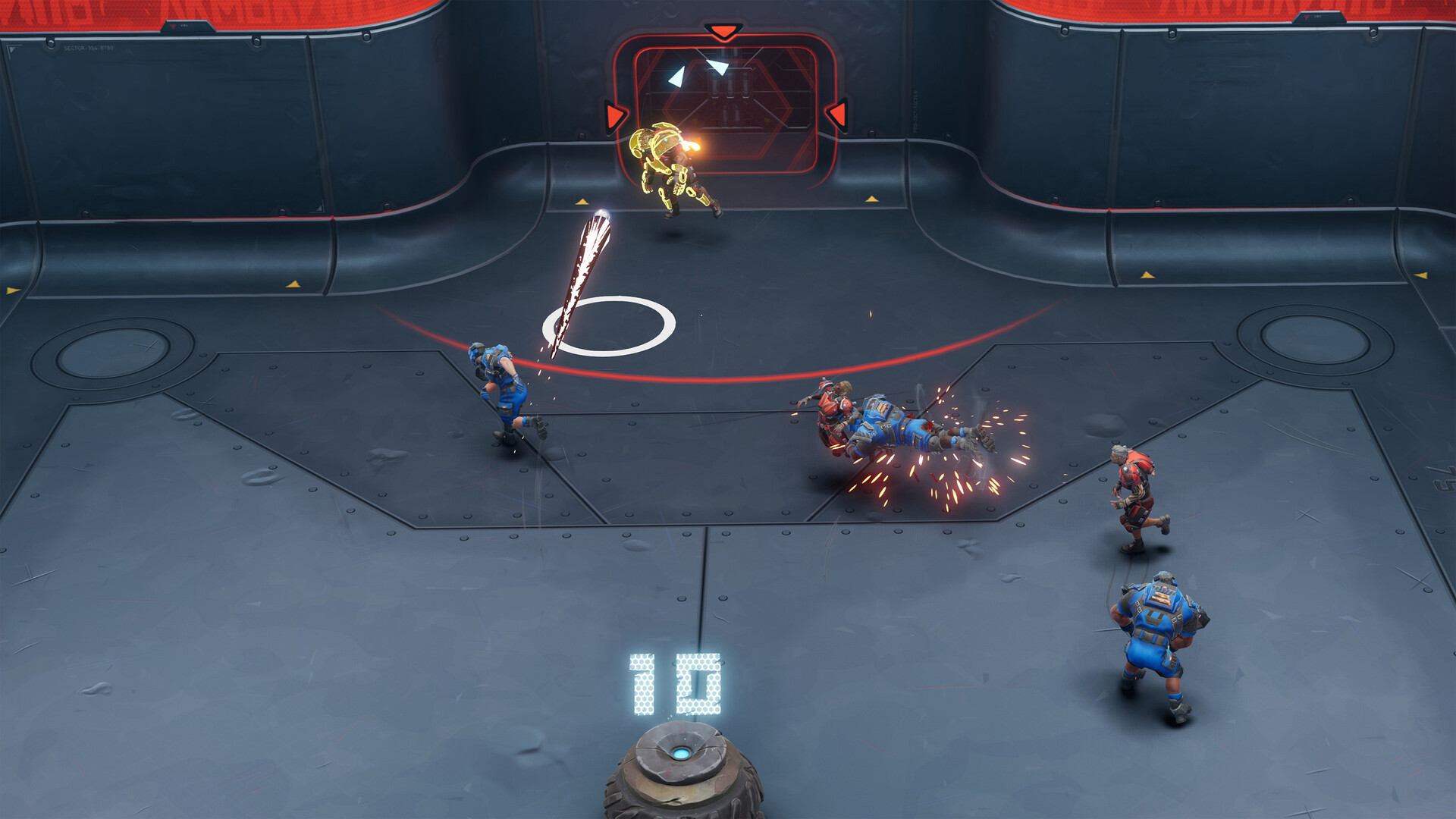
And bring it back they did. The latest Speedball launched onto Steam Early Access in late 2024, and enjoyed a full release earlier this year on PC, PS5 and Xbox Series X|S. Since then, there's been a steady stream of online reviews, and YouTube breakdowns from Rebellion themselves picking apart some of the latest in-game features, including 28 arenas (one of which is based on the classic design from the second game), light team management, and slo-mo, vicious tackling.
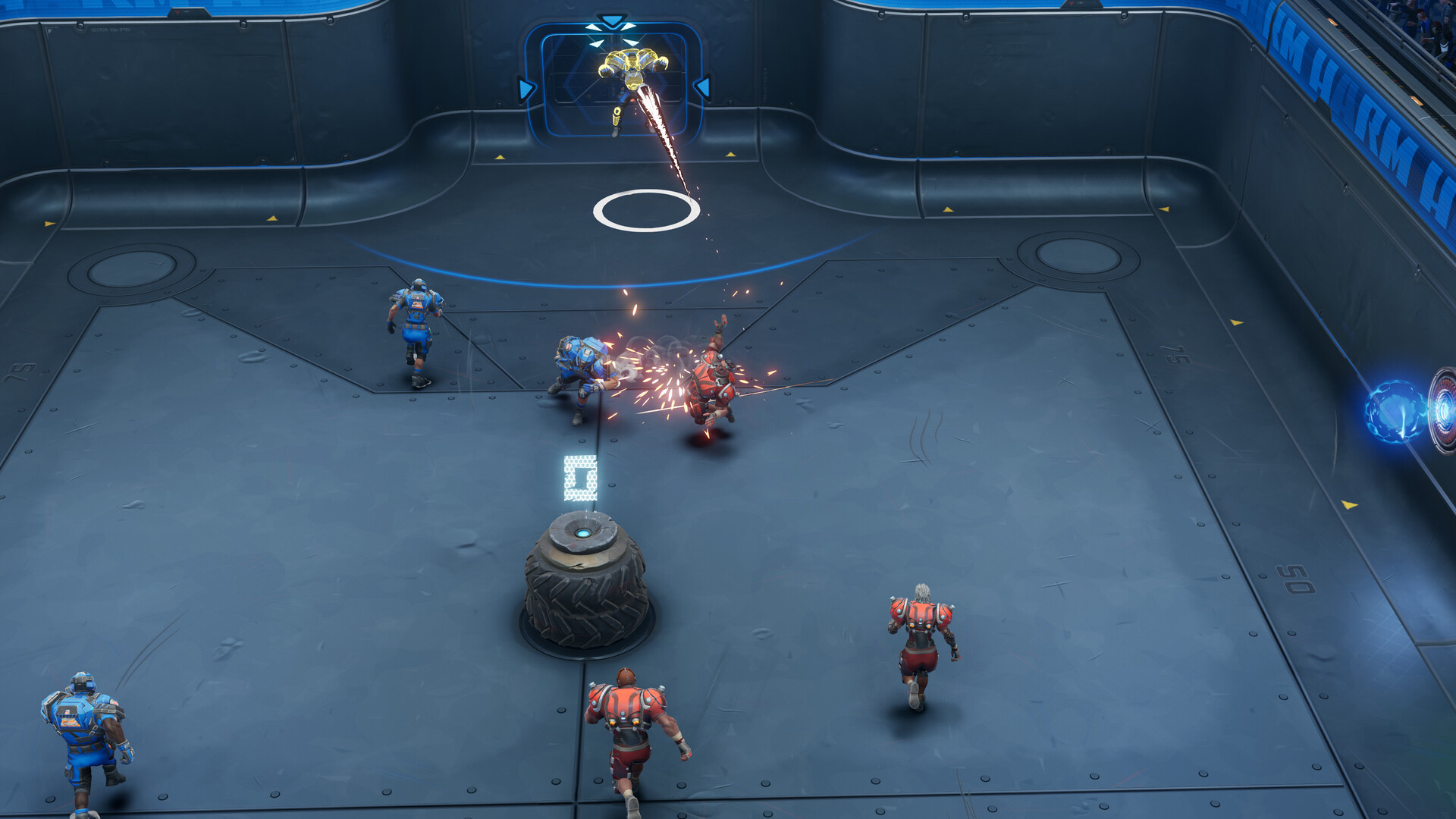
In the context of the near-future world in which Speedball is set, the ground rules are fairly simple: two teams compete in a steel arena with a goal at each end. You can score points by throwing a metal ball into the opposing team's goal, bouncing it off in-arena objects or incapacitating the other team's players.
Rebellion has remained faithful to this overall scoring system while adding a little of its own flair, including flamethrower turrets, tracking mines, and even grind rails you can leap onto to move fast across the arena.
Given Speedball's reputation for being a fast-paced game that's always only a hair's breadth from chaos, I asked Stimpson how these new elements came about:
“We’d just sit down and riff ideas ‘would this be cool, would that be cool?’” We’d talk to the art team: ‘Here’s an arena theme, can we find an element that matches it?’ Then we’d prototype and just play it."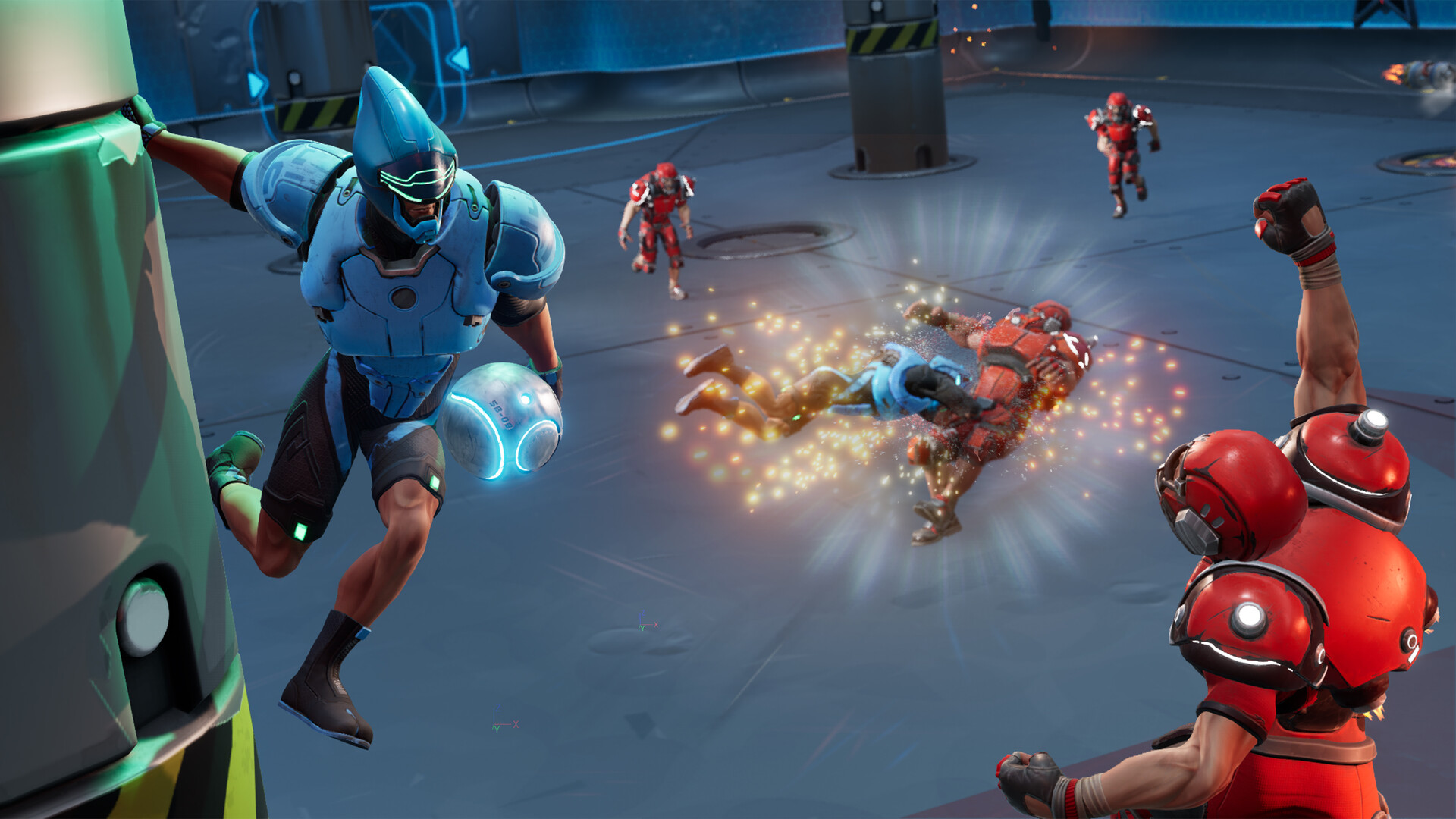 I'll leave it to readers to make up their own minds if Rebellion has hit that sweet spot between playability and anarchy, but there are definitely sufficient hazards to make each match a highlight reel without easily letting players lose track of the ball. Mines can blow open clusters of players, turrets can make you reroute paths to the goal, but I felt this just makes gameplay more wild without coming apart at the seams.
Speedball II: Brutal Deluxe was arguably more famous than its predecessor due to introducing new features. One of the most enjoyable of these was deploying grievous bodily harm as a legitimate sporting tactic. Attacking an opposing player and depleting their energy bar means they're carried off by the medibots and your team scores points. Rebellion's reboot ups the ante on this by putting it in slow motion. You can still score points for hospitalizing the opposition, but now cinematic injury cams sadistically linger on the moment of impact. Injure enough players, and the other side is forced to forfeit the match when it runs out of substitutes.
Stimpson explains. “We asked, ‘How do we make this more explicit?’ That’s where the injury cam came from: when you injure someone, we slow it down so you can see the pain on their face.”
While tackling was par for the course in the original series, Rebellion have also super-charged it by introducing jet packs. Instead of shoulder-barging someone as in the 90s, players can now rocket propel themselves into them like a laser-guided missile.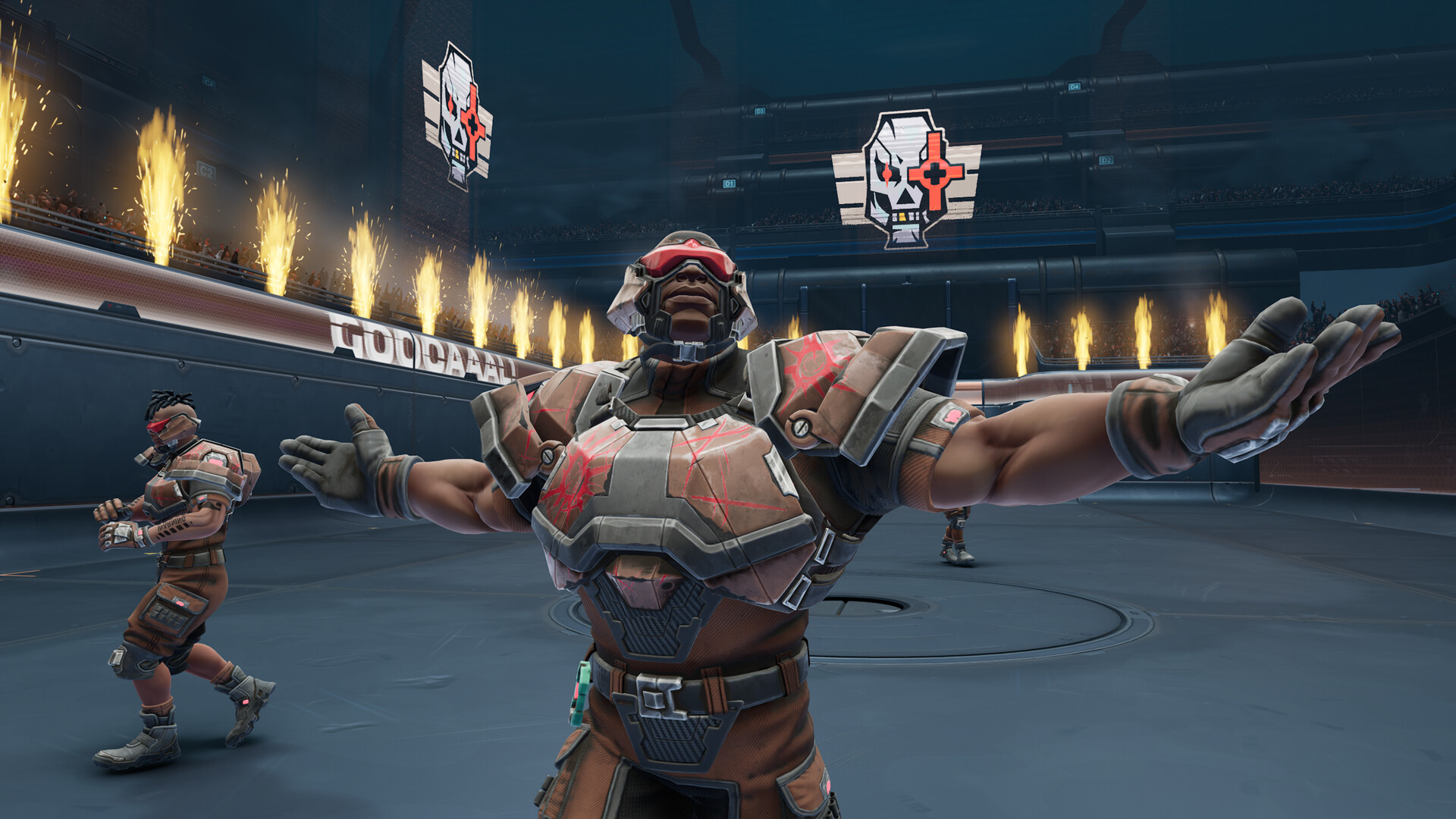 “It’s all about bringing the brutality of the sport to the forefront and pushing it as far as we can,” art director Sam Beattie explains. “Offensive tackles were a core part of the original. Jetpacks give you more agency in the arena—those really aggressive tackle moments just feel viscerally fun.”
Jim even recounted to me a Christmas party at Rebellion where two colleagues who’d never touched the game before sat down and essentially invented their own meta version on the spot:
“They just said, ‘Let’s see who can get the most tackles in this game, don’t worry about scoring goals.’ That was really nice to see, because it’s exactly what we wanted: people finding their own fun.”
As enjoyable as introducing jetpack-powered tackles might be, the same couldn't have necessarily been said of the jump from 2D to 3D. The original Bitmap Bros games were isometric 2D titles with chunky sprites and relatively simple shading. I asked Sam about the progression from that to the fully-modelled gladiators, stacked arenas, and resplendent VFX-traps we're seeing from Rebellion's creation:
"It came with many more challenges than we anticipated. Initially we set off aiming for something a lot more chrome and metallic, with the kind of grittiness you’d expect. Every time we tried to push surfaces, lighting and textural grit, it took away from readability because the game is so fast-paced, you can’t pass that much visual information.”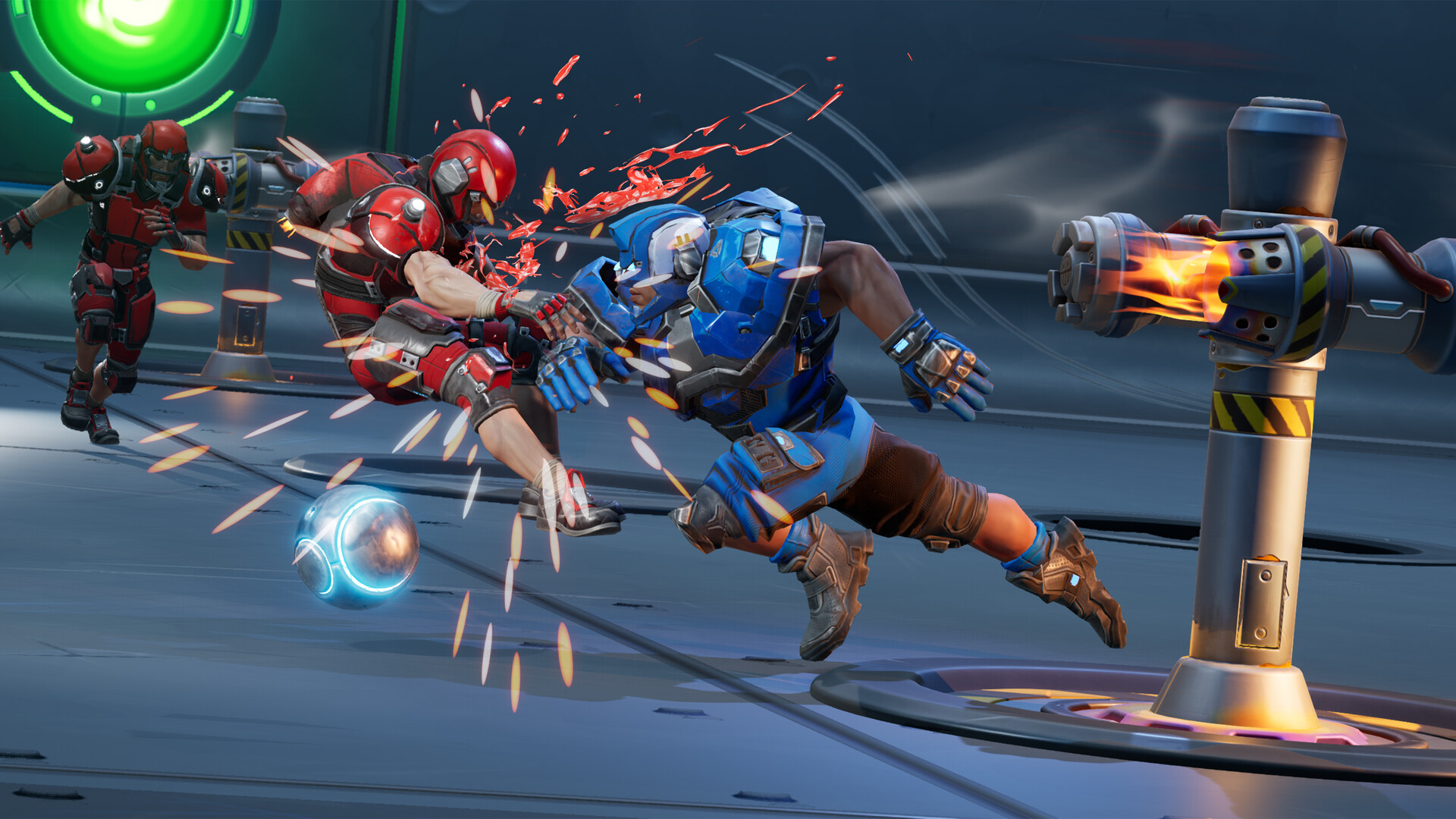 This meant some hard decisions had to made. For instance, if a highly reflective surface made it seem like there were two balls on screen, it had to go. While towering pillars with majestic shadows may have made for splendid screenshots, they can also risk reducing visibility during gameplay.
Stimpson described to me one of their teething troubles involving players being set on fire:
"If a player was running with the ball and on fire, you couldn’t tell what was going on. When we did the proper VFX pass, we had to make it subtle enough that readability didn’t suffer.”
Much as I'm skeptical that subtlety and a man being immolated can go hand-in-hand, Rebellion have clearly adopted this balanced approach throughout the design process. When the original titles were released, modern online gaming didn't exist so the order of the day was local cooperative play on the Amiga, Acorn Archimedes, and home consoles to which the Speedball games were ported.
“Local competitive play was very important to us,” Stimpson says. “We wanted that feeling back from when you’re younger, sitting next to your mate, smack-talking and trying to wind each other up. That’s fun and funny, and you get a lot from it. For me it goes back to playing GoldenEye on the N64. so much fun just because you’re in the same room."
"Even if your quadrant of the screen is the size of a postage stamp…” I observed, as I experienced a flashback to my early school days.
This focus led to some very diligent, and necessary, camera work. Speedball's traditional vertical camera was initially retained, but evolved into a side-on view tuned specifically for versus play, presumably as depth and height are easier to parse when you’re both huddled around the same monitor. Online play is also supported.
 Overall, if you're the kind of PC Gamer like me who started out flinging metal balls around Speedball arenas on the Amiga or Genesis, then you'll likely find that Rebellion's reboot is a nostalgic experience laced with just the right amount of quality of life. The pièce de resistance in my view is a team composed entirely of Mega-City One Judges, made possible as Rebellion also owns the rights to the 2000 AD Franchise.
But the team have made it clear that is also a game for those who think 'Steel Fury' is a progressive Heavy Metal band.
“For someone who’s never played the original, I think it’s the fast‑paced nature,” Stimpson says. “It’s explosive, it’s brutal, and it’s quite unpredictable. Honestly, just showing them one of the injury cams is probably enough.”
Beattie sees it as a chance to give a younger audience their own Speedball memories.
“When we set off on this project, we didn’t want to appeal purely to nostalgia,” he says. “We wanted to introduce a modern, younger audience to what’s great about Speedball so they can have those fun moments and couch co‑op stories we had. We liked the idea of sports lovers and haters uniting. You don’t have to be a sports fan to love this game.”
By Nate Drake - Nate Drake - Writing Portfolio
In the context of the near-future world in which Speedball is set, the ground rules are fairly simple: two teams compete in a steel arena with a goal at each end. You can score points by throwing a metal ball into the opposing team's goal, bouncing it off in-arena objects or incapacitating the other team's players.
Rebellion has remained faithful to this overall scoring system while adding a little of its own flair, including flamethrower turrets, tracking mines, and even grind rails you can leap onto to move fast across the arena.
Given Speedball's reputation for being a fast-paced game that's always only a hair's breadth from chaos, I asked Stimpson how these new elements came about:
“We’d just sit down and riff ideas ‘would this be cool, would that be cool?’” We’d talk to the art team: ‘Here’s an arena theme, can we find an element that matches it?’ Then we’d prototype and just play it."
Speedball II: Brutal Deluxe was arguably more famous than its predecessor due to introducing new features. One of the most enjoyable of these was deploying grievous bodily harm as a legitimate sporting tactic. Attacking an opposing player and depleting their energy bar means they're carried off by the medibots and your team scores points. Rebellion's reboot ups the ante on this by putting it in slow motion. You can still score points for hospitalizing the opposition, but now cinematic injury cams sadistically linger on the moment of impact. Injure enough players, and the other side is forced to forfeit the match when it runs out of substitutes.
Stimpson explains. “We asked, ‘How do we make this more explicit?’ That’s where the injury cam came from: when you injure someone, we slow it down so you can see the pain on their face.”
While tackling was par for the course in the original series, Rebellion have also super-charged it by introducing jet packs. Instead of shoulder-barging someone as in the 90s, players can now rocket propel themselves into them like a laser-guided missile.
Jim even recounted to me a Christmas party at Rebellion where two colleagues who’d never touched the game before sat down and essentially invented their own meta version on the spot:
“They just said, ‘Let’s see who can get the most tackles in this game, don’t worry about scoring goals.’ That was really nice to see, because it’s exactly what we wanted: people finding their own fun.”
As enjoyable as introducing jetpack-powered tackles might be, the same couldn't have necessarily been said of the jump from 2D to 3D. The original Bitmap Bros games were isometric 2D titles with chunky sprites and relatively simple shading. I asked Sam about the progression from that to the fully-modelled gladiators, stacked arenas, and resplendent VFX-traps we're seeing from Rebellion's creation:
"It came with many more challenges than we anticipated. Initially we set off aiming for something a lot more chrome and metallic, with the kind of grittiness you’d expect. Every time we tried to push surfaces, lighting and textural grit, it took away from readability because the game is so fast-paced, you can’t pass that much visual information.”
Stimpson described to me one of their teething troubles involving players being set on fire:
"If a player was running with the ball and on fire, you couldn’t tell what was going on. When we did the proper VFX pass, we had to make it subtle enough that readability didn’t suffer.”
Much as I'm skeptical that subtlety and a man being immolated can go hand-in-hand, Rebellion have clearly adopted this balanced approach throughout the design process. When the original titles were released, modern online gaming didn't exist so the order of the day was local cooperative play on the Amiga, Acorn Archimedes, and home consoles to which the Speedball games were ported.
“Local competitive play was very important to us,” Stimpson says. “We wanted that feeling back from when you’re younger, sitting next to your mate, smack-talking and trying to wind each other up. That’s fun and funny, and you get a lot from it. For me it goes back to playing GoldenEye on the N64. so much fun just because you’re in the same room."
"Even if your quadrant of the screen is the size of a postage stamp…” I observed, as I experienced a flashback to my early school days.
This focus led to some very diligent, and necessary, camera work. Speedball's traditional vertical camera was initially retained, but evolved into a side-on view tuned specifically for versus play, presumably as depth and height are easier to parse when you’re both huddled around the same monitor. Online play is also supported.
But the team have made it clear that is also a game for those who think 'Steel Fury' is a progressive Heavy Metal band.
“For someone who’s never played the original, I think it’s the fast‑paced nature,” Stimpson says. “It’s explosive, it’s brutal, and it’s quite unpredictable. Honestly, just showing them one of the injury cams is probably enough.”
Beattie sees it as a chance to give a younger audience their own Speedball memories.
“When we set off on this project, we didn’t want to appeal purely to nostalgia,” he says. “We wanted to introduce a modern, younger audience to what’s great about Speedball so they can have those fun moments and couch co‑op stories we had. We liked the idea of sports lovers and haters uniting. You don’t have to be a sports fan to love this game.”
By Nate Drake - Nate Drake - Writing Portfolio

Great article and a lovely reminder of when you and your brother and friends played Speedball together! Happy Days ☺️
ReplyDelete