

By now, many fans of horror games will be familiar with Trinanon’s woes. Rebirth was initially released back in 2020 on Windows and PlayStation 4, the sequel to 2010’s Amnesia: The Dark Descent and 2013’s Amnesia: A Machine for Pigs. Both of the latter games have languished unplayed in my Steam back catalogue for years, but thankfully, you don’t need to have played them to enjoy Rebirth.
And I’m pleased to confirm I did enjoy Rebirth quite a bit. One of my benchmarks for enjoying a game is it giving me an experience I haven’t had before. On paper, it doesn’t. Rebirth is boilerplate horror gaming, delivering a spooky atmosphere, an isolated heroine, monsters hunting you, and tense environmental puzzles.
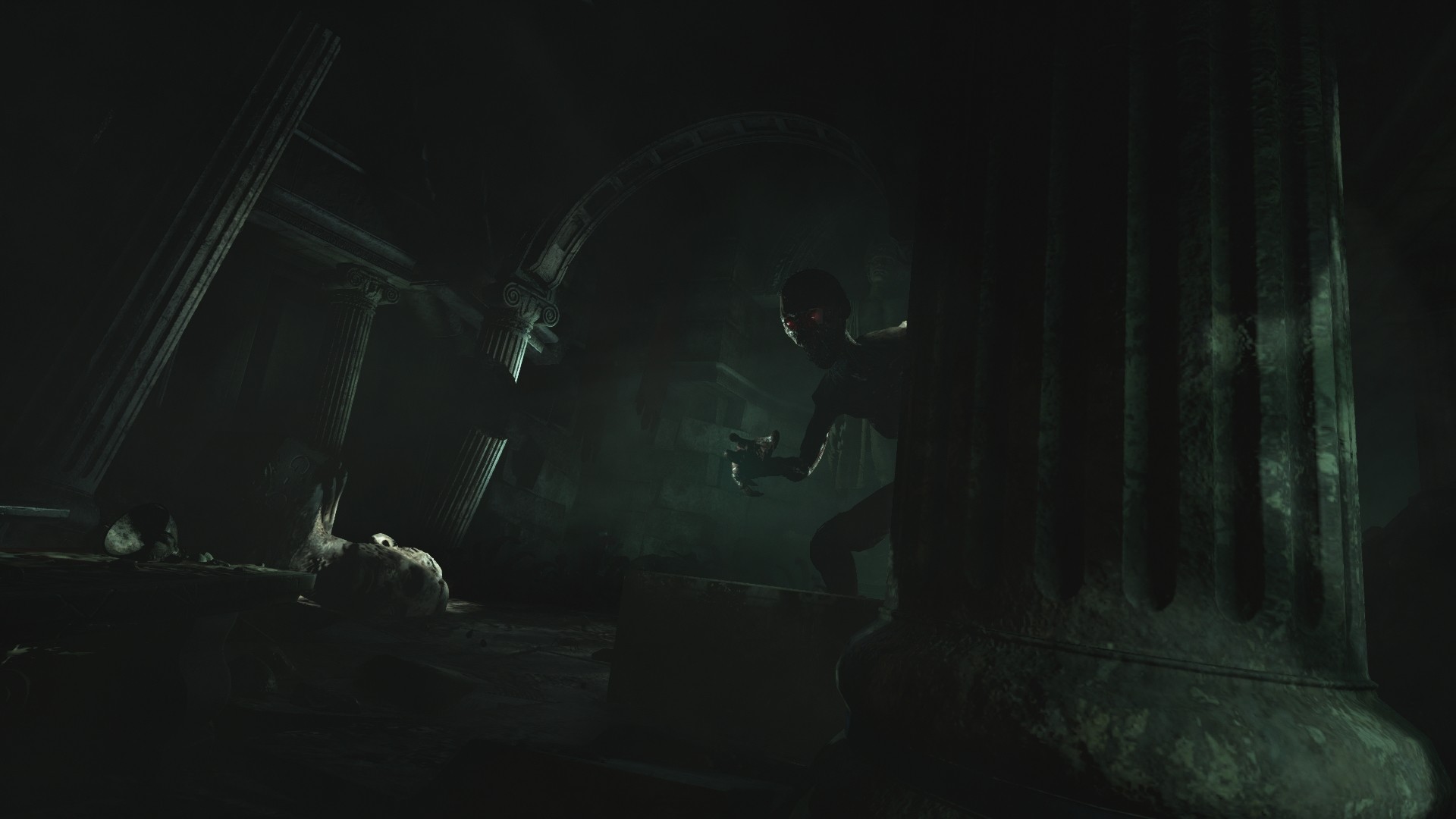
All this familiar stuff is thrown into a new light by having you play as a pregnant woman with a visible belly bulge, complete with a button dedicated to checking on your unborn baby. This instantly cranks up the tension by making me far more cautious about her safety: wincing every time I tumbled off a ledge and took fall damage, gingerly tiptoeing across planks suspended over gaping chasms, and feeling extra vulnerable in the presence of monsters.
In a way, Rebirth has its cake and eats it by not having Tasi’s pregnancy affect the game mechanics (you can still hold down the left shoulder button to sprint even in the late stages of her pregnancy), but it really does succeed in giving you a new perspective on horror.
I also appreciate that the puzzle-solving doesn’t hold your hand and remains logical throughout. Sometimes you’re simply tasked with getting through an environment, sometimes you’re given some weird otherworldly device and expected to figure out how it works. Both are fun and, while I was briefly stumped a couple times, I never got frustrated.
So, it thrilled me, intrigued me, scared me, and I had fun figuring things out. Amnesia: Rebirth: a good game you should buy… …is what I’d be saying if this were a review of the PC version.
In a way, Rebirth has its cake and eats it by not having Tasi’s pregnancy affect the game mechanics (you can still hold down the left shoulder button to sprint even in the late stages of her pregnancy), but it really does succeed in giving you a new perspective on horror.
I also appreciate that the puzzle-solving doesn’t hold your hand and remains logical throughout. Sometimes you’re simply tasked with getting through an environment, sometimes you’re given some weird otherworldly device and expected to figure out how it works. Both are fun and, while I was briefly stumped a couple times, I never got frustrated.
So, it thrilled me, intrigued me, scared me, and I had fun figuring things out. Amnesia: Rebirth: a good game you should buy…
Okay, perhaps that’s a teensy bit dramatic. This is a good game, sadly, Abylight Studios’ port to Switch 2 is a bit half-arsed. For example, the PR blurb for this re-release promises that Rebirth has been “optimised for the new hardware”. They’re either telling porkies or have a very different definition of “optimised” than I do.
The Switch 2 isn’t top-of-the-line gaming hardware, but if it can run decent-looking versions of Cyberpunk 2077 and Resident Evil: Requiem, it could certainly be doing a better job of running this!
Rebirth runs at 30fps in both handheld and docked modes and suffers frequent frame drops to the point that I found the visibly jerky first-person camera movement mildly nauseating. It’s also not a particularly sharp game, with muddy visuals, low-res textures, and functional level geometry. Frame-rate woes are forgivable if a game is delivering excellent visuals, but let’s just say this is a game more about vibes, puzzles, and narrative than pushing the graphical envelope.
Granted, it’s easy to play backseat developer and assume it shouldn’t be that hard to get this running at a fixed 60fps at 1080p on Switch 2. However, given that this runs on Frictional Games’ in-house HPL 3 engine (which they can presumably provide full documentation for) and that the recommended specs for the 2020 PC version are a Core i5, 8GB of RAM, and an Nvidia GTX 680 (a graphics card released in 2012!), there’s no technical reason I can see that this shouldn’t be buttery smooth when ported to Switch 2. Perhaps more emblematic of a lack of ambition in this port is that it doesn’t make any use whatsoever of the Switch 2 Joy-Con’s mouse mode. From the first few minutes, you can tell Rebirth was designed around clicking and dragging with a mouse to manipulate objects, with joypad controls clumsily translating this to holding the right trigger and moving the right stick.
For all I know, there really are insurmountable hardware limitations that prevent this from running smoothly on Switch 2. But I do know for certain there’s absolutely no reason why they couldn’t implement Joy-Con mouse controls in the style of Metroid Prime 4. All I can conclude is that this is a quick n’ dirty port that’s been thrown out of the door as cheaply as possible, and this game deserves better than that.
SUMMARY
Amnesia: Rebirth is a fine horror game that you won’t regret playing.
The Switch 2 isn’t top-of-the-line gaming hardware, but if it can run decent-looking versions of Cyberpunk 2077 and Resident Evil: Requiem, it could certainly be doing a better job of running this!
Rebirth runs at 30fps in both handheld and docked modes and suffers frequent frame drops to the point that I found the visibly jerky first-person camera movement mildly nauseating. It’s also not a particularly sharp game, with muddy visuals, low-res textures, and functional level geometry. Frame-rate woes are forgivable if a game is delivering excellent visuals, but let’s just say this is a game more about vibes, puzzles, and narrative than pushing the graphical envelope.
Granted, it’s easy to play backseat developer and assume it shouldn’t be that hard to get this running at a fixed 60fps at 1080p on Switch 2. However, given that this runs on Frictional Games’ in-house HPL 3 engine (which they can presumably provide full documentation for) and that the recommended specs for the 2020 PC version are a Core i5, 8GB of RAM, and an Nvidia GTX 680 (a graphics card released in 2012!), there’s no technical reason I can see that this shouldn’t be buttery smooth when ported to Switch 2.
For all I know, there really are insurmountable hardware limitations that prevent this from running smoothly on Switch 2. But I do know for certain there’s absolutely no reason why they couldn’t implement Joy-Con mouse controls in the style of Metroid Prime 4. All I can conclude is that this is a quick n’ dirty port that’s been thrown out of the door as cheaply as possible, and this game deserves better than that.
SUMMARY
Amnesia: Rebirth is a fine horror game that you won’t regret playing.
But please, play it anywhere other than Switch 2!
6/10
💧MELTING💧
My discovery of https://cardmates.co.uk/online-casinos/relax-gaming happened during a boring Sunday afternoon while I was searching for new slot games to play in the UK. I’d been stuck replaying the same few titles for months, so I wanted something different. What interested me most was the breakdown of casinos featuring Relax Gaming software because I genuinely enjoy their style of slots. Some are chaotic, some are weirdly funny, and a few nearly made me spill coffee from laughing at the animations. I appreciated that the page focused on licensed casinos too, since I’ve had bad experiences with random gambling sites in the past.
ReplyDelete